
Income Shares Model for Child Support: Incentive Problems
The income shares model for child support can penalise higher earnings and turn small custody differences into large payment changes.
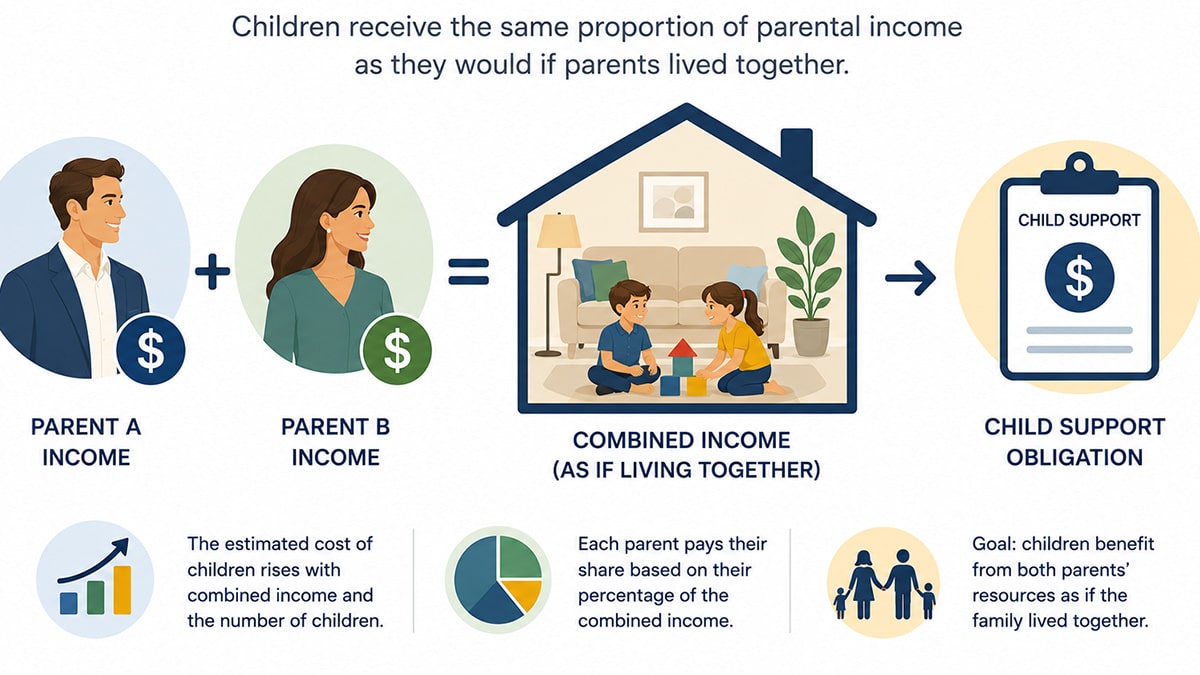
The income shares model is the most widely used approach to child support despite creating perverse incentive problems.
- Under the framework, separated parents have their incomes pooled for the purpose of calculating child support.
- Effectively, the formula estimates what the parents would spend on their children if they still lived together and operated as a married couple.
Because the parents are actually apart, the calculation method can increase financial tensions around income earning and custody. Parents share their wealth based on incomes and care provided. Payments are not tied to the typical cost of raising a child.
US states using the income shares model
The income shares model is used by 41 US states. Although the underlying principle is similar, each state applies its own income definitions, cost tables, care adjustments and additional expenses.
- Alabama
- Arizona
- Arkansas
- California
- Colorado
- Connecticut
- Florida
- Georgia
- Idaho
- Illinois
- Indiana
- Iowa
- Kansas
- Kentucky
- Louisiana
- Maine
- Maryland
- Massachusetts
- Michigan
- Minnesota
- Missouri
- Nebraska
- New Hampshire
- New Jersey
- New Mexico
- New York
- North Carolina
- Ohio
- Oklahoma
- Oregon
- Pennsylvania
- Rhode Island
- South Carolina
- South Dakota
- Tennessee
- Utah
- Vermont
- Virginia
- Washington
- West Virginia
- Wyoming
The National Conference of State Legislatures provides links to the individual child support guidelines. Guam and the US Virgin Islands also use the model.
How the income shares calculation works
Cost tables establish the basic child support obligation. A rise in payer income can then increase support through both the income share effect and the cost-of-children effect.
Cost tables
Cost tables convert the parents’ combined income and number of children into a basic child support obligation.
Each income shares state has its own cost-of-children schedule. The estimated cost of children rises with combined income and the number of children, but at a declining rate.
Income share effect
The income share effect is the increase in the payer’s percentage share of the child support obligation as their income rises relative to the receiver’s income.
The payer and receiver are each responsible for a percentage of the basic obligation based on their share of combined income. As the payer’s income rises while the receiver’s income stays unchanged, the payer becomes responsible for a larger percentage.
When the receiver has no countable income, the payer’s income share is already 100%. Further income increases therefore have no income share effect.
Cost of children effect
The cost-of-children effect is the increase in the basic child support obligation as the parents’ combined income rises.
The cost-of-children effect generally adds to the income share effect. It helps keep child support down for low-income payers but adds to the increase as payer income rises.
Incentive problems with the income shares model
The income shares model can create two damaging incentives. The first is that parents are discouraged from earning their maximum incomes. For payers especially, a higher income can significantly increase payments. The second is that parents are encouraged into custody battles because the financial stakes are elevated.

Demoralizing effective tax rates
When a support order is recalculated after payer income rises, taxes and additional child support can absorb a large share of the increase. The following example applies the 2026 Illinois guidelines using standardized net incomes.
Children: 2
Parenting time: All overnights with the receiver
Receiver gross income: $60,000 per year
Payer gross income: $30,000 to $150,000 per year
- At $30,000, the guideline payment is about $612 per month, or $7,347 per year.
- At $150,000, the guideline payment is about $1,999 per month, or $23,986 per year.
- Across each $30,000 income increase, taxes and additional child support absorb about 42% to 49% of the extra gross income.
Across the full range, the payer earns an extra $120,000 but keeps about $64,409 after additional taxes and child support. The combined withdrawal rate is 46.3%.
Calculation basis: The example uses the Illinois income shares tables for 2026 and excludes health insurance, child care, maintenance and other adjustments.
Excessively high or low payment rates
A useful measure is the increase in support caused by moving away from equal care. Comparing a 7:7 arrangement with an 8:6 arrangement isolates the financial effect of one extra night with the receiver over a two-week period.
Children: 2
Gross incomes: $60,000 for the receiver and $150,000 for the payer
Payment with equal care: About $821 per month, or $9,852 per year
Payment with 8 nights for the receiver and 6 for the payer: About $1,132 per month, or $13,585 per year
One extra night with the receiver over a two-week period raises the payment by about $311 per month, or $3,732 per year. The receiver provides approximately 26 nights above an equal split, producing an additional payment of about $143 per extra night.
The formula turns a small difference in care into a large financial gain for the receiver. Thus, there is an incentive against simply agreeing to an equal parenting schedule.